units10 min
Unit Conversion: SI and Precision
A worked guide to unit factors, temperature offsets, significant digits, and the difference between decimal and binary data units.
Read more→Free online unit converter: instantly convert length, weight, temperature, volume, area, speed, time, data, and energy units. Fast and accurate. Use now.
Processing: local in your browser
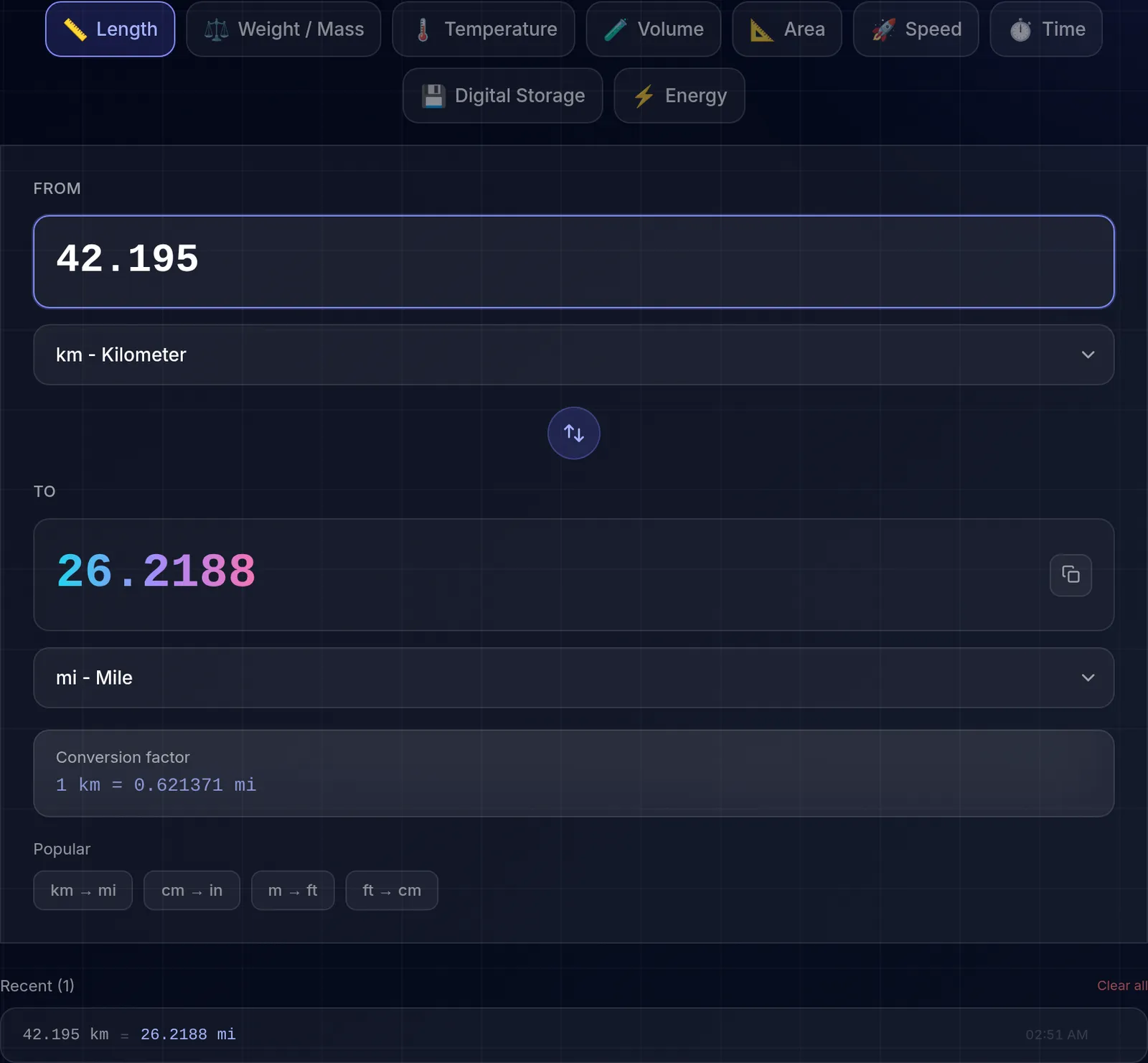
Convert between units of length, weight, temperature, volume, area, speed, time, digital storage, and energy. Full support for metric and imperial systems.
Our converter includes built-in unit search, recent conversion history, visible conversion formulas, and popular conversions for each category.
Kilometers to miles, kilograms to pounds, Celsius to Fahrenheit, liters to gallons, square meters to square feet, GB to MB, calories to joules.
The metric system (meters, kilograms, liters) is the international standard used by the vast majority of countries worldwide. The imperial system (feet, pounds, gallons) is primarily used in the United States, Liberia, and Myanmar. Understanding both systems is essential for international trade, travel, cooking with foreign recipes, and scientific communication. Our converter makes it easy to switch between both systems with precision, displaying the formula used in each conversion so you can learn while you convert.
Temperature conversion is one of the most searched and also one of the most confusing. To convert Celsius to Fahrenheit, multiply by 9/5 and add 32: for example, 25°C equals 77°F. For the reverse conversion, subtract 32 and multiply by 5/9: so 98.6°F is 37°C (normal body temperature). The Kelvin scale, used in science, is obtained by adding 273.15 to degrees Celsius: 0°C equals 273.15 K. Our converter performs these calculations automatically and displays the formula applied.
In the digital age, understanding storage units is essential. A byte (B) is the basic unit and equals 8 bits. A kilobyte (KB) is 1,024 bytes, a megabyte (MB) is 1,024 KB, a gigabyte (GB) is 1,024 MB, and a terabyte (TB) is 1,024 GB. A simple text document takes up a few KB, a high-resolution photo between 3 and 10 MB, an HD movie between 4 and 8 GB, and a modern hard drive typically holds between 512 GB and 2 TB. Our converter lets you quickly switch between bits, bytes, KB, MB, GB, TB, and petabytes (PB).
International recipes mix systems: a US recipe uses cups and degrees Fahrenheit, while a European one uses grams, milliliters, and degrees Celsius. Converting volume to weight is not always direct, because a cup of flour and a cup of sugar weigh differently; for liquids, though, 250 ml is roughly one cup. For the oven, 180°C is about 350°F, one of the most useful equivalences when following foreign recipes. The converter helps with volume, weight, and temperature, but check whether the recipe means weight or volume before you convert.
A few confusions come up again and again. The US gallon (3.79 L) is not the same as the British imperial gallon (4.55 L), so it helps to know which one the source uses. Weight and mass get mixed up in everyday language: kilograms measure mass and newtons measure force, even though daily use treats them interchangeably. And in energy, a kilowatt (kW) is power while a kilowatt-hour (kWh) is energy used over time: they are not interchangeable. Always check the exact starting unit so you do not carry the error into the result.
Learn more with related in-depth guides and tutorials.
A worked guide to unit factors, temperature offsets, significant digits, and the difference between decimal and binary data units.
Read more→Use reference rates correctly, understand provider spreads, and learn exactly where ToolsFree obtains its daily currency data.
Read more→Learn JSON's actual grammar, diagnose common parser failures, and format or inspect data locally without confusing syntax validation with schema validation.
Read more→Conversion factor
1 km = 0.621371 mi
Popular